Artificial intelligence is fundamentally reshaping how organizations operate. Across every industry, Large Language Models (LLMs) are emerging as the new operating system for modern businesses, serving as the intelligent interface that transforms how employees access information, make decisions, and do their jobs.
However, this transformation faces an uncomfortable truth: trusted, secure, and real-time enterprise data is the electricity that powers the new operating system, but for many, there’s been a series of power outages. Gartner predicts, for example, that organizations will abandon 60% of AI projects that are not supported by AI-ready data. Not because the technology isn’t powerful enough, but because the data feeding these systems isn’t ready to fuel it.
Trusted data is the make-or-break factor for enterprise AI success—not the LLM that you choose. Creating an enterprise data strategy in place today is the key.
AI as your organization’s new operating system
From the boardroom to the front lines, a frenzied revolution is underway. Marketing teams analyze customer feedback through conversational analytics rather than complex dashboards. Financial analysts ask AI to identify spending patterns and generate reports. Human resources departments are leveraging AI to screen resumes and schedule interviews. This is the present reality of information work.
The transformation extends beyond individual tasks to entire workflows. AI agents are handling multi-step processes autonomously across customer service, supply chain, and project management.
What once required multiple people and manual handoffs can now be orchestrated through intelligent automation, creating entirely new possibilities for how organizations operate and compete. We’re not far away from a completely new way of working. Instead of having multiple screens with a half dozen or so applications running at once, Agents will replace all of them. Agents will handle all your tasks, from building a dashboard to running sales reports and generating charts; the day-to-day tasks for most white-collar jobs will run through agents and their associated LLMs.
The hidden barrier to AI success: data quality
Despite the promise and the progress, many AI initiatives are hitting a wall in the enterprise. The culprit isn’t a lack of sophisticated algorithms or computing power; it’s the sobering reality and sorry state of organizational data.
Most large enterprises operate with fragmented data across more than 400 systems, with information scattered across different departments and formats. Customer data resides in CRM systems, financial information is stored in ERP platforms, employee records are housed in HR databases, and operational metrics are trapped in departmental spreadsheets.
Exhibit 1: Siloed data is AI’s kryptonite
Permission granted by Reltio
AI’s biggest obstacle isn’t algorithms or compute—it’s the sorry state of enterprise data. Most enterprises juggle hundreds of disconnected systems, leaving customer, financial, employee, and operational data siloed and inconsistent. When AI pulls from these sources, the results are incomplete, outdated, or flat-out wrong, eroding trust and undermining decisions. No surprise that while 97% of leaders see generative AI as game-changing, nearly half admit they lack the high-quality data to power it. As Forrester notes, poor data quality has become the primary limiting factor for AI adoption—proof that “garbage in, garbage out” has never been more true.
The new rules of data in the AI era
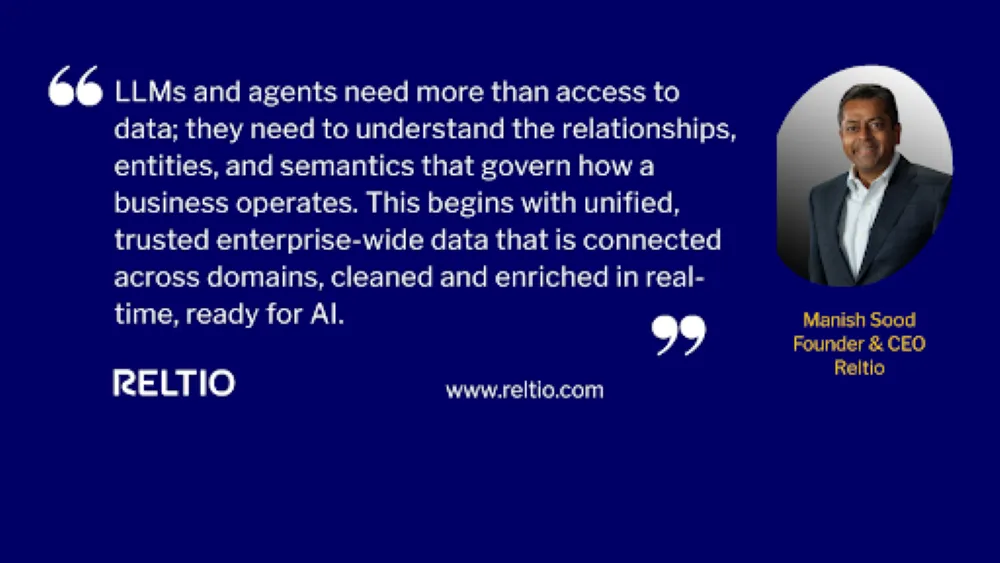
“The game has changed and new rules are needed,” says Manish Sood, founder and CEO of Reltio, the leading data unification platform. “We’re entering the Age of Intelligence, when AI agents generate content, make decisions, and continuously learn. In this environment, the legacy rules of data are cracking.”
Permission granted by Reltio
The new enterprise data rules are straightforward: data must be connected across all business functions, accessible in real time, and structured in ways that AI can readily consume. This means moving beyond spreadsheet-based workflows and isolated databases toward integrated data architectures where customer interactions, financial metrics, operational performance, and market intelligence flow together seamlessly.
Organizations that master this transition transform AI into a significant competitive advantage. On the other hand, organizations that invest millions in AI technology while ignoring their data foundation are essentially building sophisticated systems on quicksand.
Preparing your organization for an AI-driven future
The strategic imperative is clear: competitive advantage no longer comes from having the best applications or even the most advanced AI models. It comes from having the most trusted, AI-ready data to fuel intelligent operations.
Forward-looking companies like Mastercard and L’Oréal show what it takes to unlock AI’s potential: a unified data foundation that delivers complete, accurate, and real-time context. Mastercard overcame the challenge of integrating fragmented customer, merchant, and product data across acquisitions to create a 360-degree view that fuels smarter decisions and stronger customer experiences. L’Oréal built its transformation on the recognition that data is the company’s most valuable, yet underutilized, asset—turning accurate and connected data into the engine for direct-to-consumer growth. Their progress underscores the larger lesson: true competitive advantage in the age of AI won’t come from the most advanced models, but from the most trusted, AI-ready data.
Companies that continue operating with fragmented information across departments and outdated manual processes will find themselves increasingly unable to compete against organizations where AI agents can access complete, real-time context to make accurate decisions at scale.
Ready to build your AI-ready data foundation? Explore Reltio’s exclusive research, which uncovers the 10 new data rules for succeeding in the “Age of Intelligence.”
About the Authors
 |
Ansh Kanwar Chief Product Officer Reltio Ansh Kanwar is Chief Product Officer (CPO) overseeing Reltio’s global software engineering, product management, and technology operations. Ansh has extensive experience in product management, software development, product marketing, security, cloud computing, and technology operations. Over the last 23 years, he has held numerous senior technical and management roles, including at Citrix Systems, where he served as Vice President, Technology Operations, and LogMeIn, where he served as Chief Technology Officer, and General Manager, Products and Technology at Onapsis. Ansh is a public speaker and loves discussing Data Unification and Management, AI in Data, Data Products, the Ethical use of Data, and building at scale SaaS products. He has a Bachelor’s in Computer Engineering from Delhi University, an MS in Electrical and Computer Engineering from the University of California, Santa Barbara, and an MBA from the MIT Sloan School of Management. He lives in Cambridge, MA. |