Therabody has taken a watch and learn approach to AI.
As its customers gravitate to different ways of doing business, the company has responded by building out the tools needed to keep pace and, in many cases, running them on its own managed cloud infrastructure.
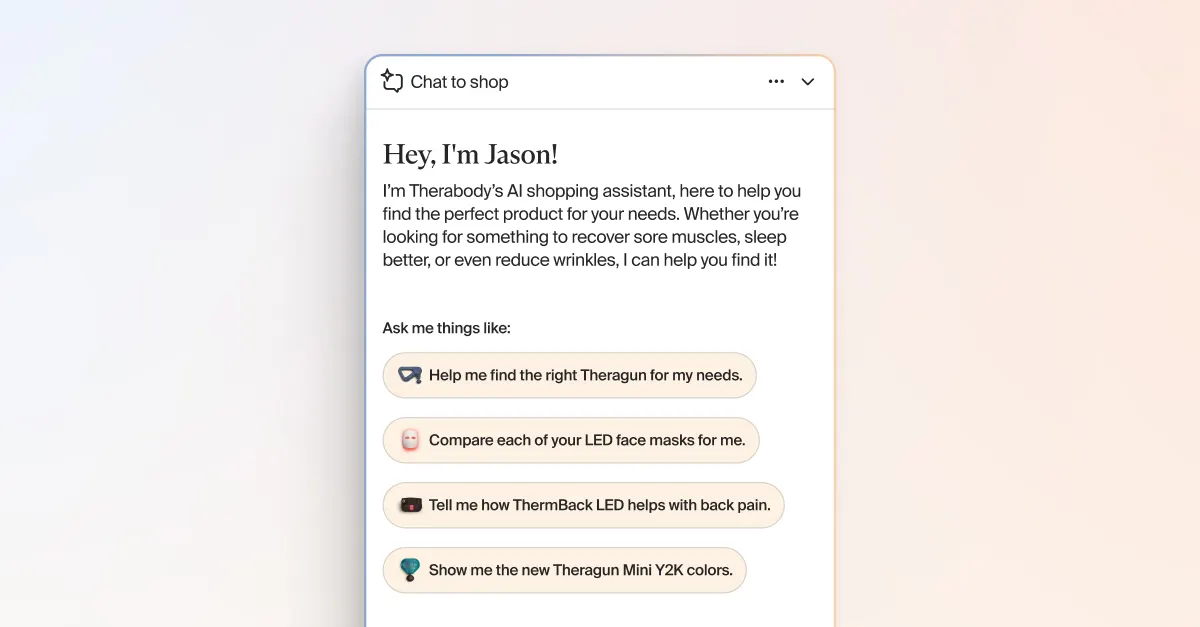
That’s the case with the wellness technology brand’s latest effort, an AI-powered shopping assistant called Jason that launched in October and is built using Agentic Shopping Assistant on AWS.
Founded in 2016, Therabody has been keeping a pulse on AI tools, relying on data signals to assess how customers arrive at the site and interact with products, according to Caitlin Berzok, SVP of digital at Therabody.
Last holiday season, the company noticed that traffic driven by OpenAI’s ChatGPT skyrocketed, which changed how it thought about AI features for customers, she said.
“All the signals in the marketplace were that this wasn’t an edge case anymore,” Berzok told CIO Dive, indicating that it was time for the company to bring its own conversational AI assistant to market.
It isn’t the only one. Retail giants such as Walmart, Target and others are also deploying shopping assistants to provide new customer experiences.
Therabody’s Android and iOS mobile app is built on AWS infrastructure, through which the team had previously built and deployed its first AI tool, an AI recommendation engine. The company relied on AWS model flexibility, working with Amazon Bedrock, a platform for building generative AI applications, to “swap out models as we saw fit in order to get the best results,” Berzok said.
When the tech giant in May launched Agentic Shopping Assistant on AWS — a generative AI tool for companies to develop and deploy intelligent shopping assistants — Therabody jumped on it, launching Jason, Berzok said.
Building Jason
Deciding to move forward with Jason stemmed from a history of learning and waiting for the right opportunity with AI, Berzok said. The company traditionally took what Berzok described as a thoughtful approach to integrating AI within their environment, both at the front and back ends.
“One of the things I always tell my team is, ‘We don’t AI for AI’s sake,’” she said. “We didn’t jump on the early AI wave, but we were really looking at: How is it evolving, how are consumers reacting to it, identifying what are the use cases that make sense for our business and then implementing that thoughtfully. That’s been our methodology.”
Before opting for the AWS service to build Jason, Berzok said her team conducted a build-versus-buy analysis and assessed other SaaS products and turnkey solutions. Some critical elements that swayed Therabody toward AWS was the ability to build customized guardrails and iterate quickly, Berzok said.
AWS also worked with Therabody to control the tool’s responses and recommendations, preventing unbacked claims or statements.
“AI is AI, it restates things however it wants to and can hallucinate,” she said. “There are certain things we couldn’t allow it to because when you’re giving someone a recommendation on pain, you have to be right. We were able to work with [AWS] within our constraints and create custom parts of the implementation that could allow us to do that and keep our friends in legal and regulatory happy with it as well.”
Permission granted by Therabody
After opting to go with the AWS service, Berzok said it took her team less than 90 days to build and deploy Jason. The assistant navigates consumer’s questions and helps direct to the right product. It also runs on Therabody’s managed AWS infrastructure, which gives the company end-to-end ownership as well as UX and UI flexibility, according to a blog post on Jason.
“Being able to bring that to life in a digestible, conversational way that consumers can not only get to the right product for them, but have the trust that it’s going to work for them, we’ve seen some good indicators that’s how people are engaging with it,” Berzok said.
Jason can also guide customers to the point of purchase, where they can initiate a checkout directly from the chat. The tool doesn’t collect credit card information, but can hand customers off to Therabody’s Shopify partner to complete checkout or to the company’s customer service program, Berzok said.
Therabody built a custom dashboard to update context quickly for Jason and monitor chats, Berzok said. The dashboard can pull information from Therabody’s existing infrastructure, including from sources such as its Shopify product detail pages.
“If something goes out of stock, it’s not going to show up,” she said. “We have those integrations and controls in place. Having everything singing from the same sheet of music has created a much more seamless and scalable experience for us.”
Jason has been live for two months and the company has seen early indicators of positive customer engagement, but Therabody plans to continue adding context for the tool and identifying more use cases, according to Berzok.
Throughout the holiday season, Berzok said the company will assess whether customer wayfinding improved and will track conversion rates to see not only if customers found the right product, but ultimately made the purchase.