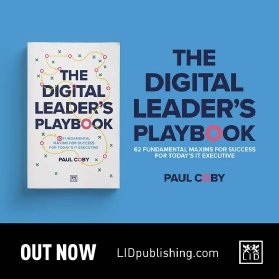
Chief information officer (CIO) Paul Coby has distilled more than a quarter of a century of experience running the IT at the UK’s most prominent companies – including British Airways, John Lewis, Johnson Matthey and Persimmon Homes – into an essential handbook for IT leaders.
The digital leader’s playbook began life in 2005 when Coby began making notes about his experience during a long and tedious meeting. It has gone through several iterations as Coby has changed his thinking and technology has developed.
The book presents 62 maxims. They cover everything from the impact of artificial intelligence (AI) to managing the board, dealing with technology suppliers, managing the IT department, managing relations with other parts of the business, and organising your time.
In this extract, Coby explains why CIOs should love the business they work for, not just the technology; why they should make sure executives have priority IT service; and why top technical specialists really matter.
He also explains why CIOs should make sure they cut the cost of their IT estates each year, obsess about the total cost of ownership of technology, and why suppliers are just as important as internal IT staff.
But Coby acknowledges that people matter more than technology, and when things go wrong, having the right relationships with the right people is essential.
CIOs are the personification of IT
As CIO, you are the personification of IT. Be vocal about your team’s successes and be honest about your mistakes.
As CIO, you are the face of the IT function in your organisation. And, as the CIO, you set the tone for everyone in IT.
So, ensure that IT is seen as a key partner of the business, and prove it by paying attention to every issue brought to your attention and following up where necessary.
Try not to talk about the business and IT as if they are separate entities. You and your team are just as integral to the company as sales, operations or finance. Always talk about our business needs and what we should do.
Action: Explain a success to others in the organisation and why it worked. Bring out how collaboration between their teams and IT, working to aligned plans and objectives, made good things happen for everyone involved.
Love your business
You’re not just there to do IT – you’re there to build new homes for families, deliver Christmas presents on time, or fly people away on their holidays.
Build your IT strategy around your company’s direction. Invest time in understanding the strategic issues that are impacting the business, your CEO and your board.
There will be economic and environmental challenges, competitor action and regulations. Identify and analyse these challenges, and then get your IT department lined up behind your company’s strategy.
Magic happens when IT really locks into what the business is trying to achieve, and when the business trusts its IT professionals to deliver for it.
I’ve been fortunate to experience this on various occasions, most memorably when we launched ba.com and johnlewis.com – in both cases, a matter of life or death for the business.
Alignment of objectives requires understanding and trust. What is needed on the IT side is real comprehension of the dynamics of the business – by you, your leadership team and everyone working in IT. And on the other side of the equation, you need trust from the business that IT is completely aligned and in lockstep with the bigger picture.
IT and the business need to think and act as one team. Joint strategic workshops help deliver this by breaking down barriers and building relationships. Appointing a relationship director as the bridge between IT and the customer departments is often seen as an extravagance, but it can be invaluable in breaking down barriers.
Action: Ask each of your executive colleagues what their most important digital priorities are.
About Paul Coby: Paul Coby has worked as CIO for some of the UK’s most prominent companies over the past 25 years. He has led major projects at British Airways, John Lewis, chemicals and metals group Johnson Matthey, and, in his current role as group CIO, Persimmon Homes, one of the UK’s largest house builders. He has also sat as a non-executive director on the boards of companies including Pets at Home, Virgin Money and P&O Ferries
Top people’s tech matters
They will judge the quality of you and the IT function by whether their personal IT works. Support the basic IT services for your chair, CEO and executive team exceedingly well. They do not use the much more important operational or financial systems themselves, but they do depend on their mobile phones, laptops and iPads, whether they’re at the office, at home or travelling abroad.
How can they rely on you to run their major systems if you can’t get these basics right?Make one of your managers accountable for top people’s tech, and make sure there’s a smart, articulate colleague ready to support them. And, of course, provide excellent support for their PAs when they have a problem or requirement.
There is a school of thought among some IT support teams that C-suite users should get the same service as, say, customer service agents. While I understand the democratic thinking in terms of immediate need, keeping senior leaders up and running is more valuable to your company than doing so for a rank-and-file user. That is, after all, why they are paid more than the rest of us.
I remember being rung up one evening by my CEO, who was having mobile phone issues during a critical negotiation. Fixing this really did matter.
Make sure your C-suite executives’ IT works well. Then, they might start to trust you with a £10m investment in cyber security or implementing AI in their production lines.
The best way to do this is to provide them (and, crucially, their PAs or secretaries) with access to a specialist support line and some people in your team they can get to know and trust.
Action: Ask for a review of the number and severity of C-suite executive IT incidents and act accordingly.
Keep IT simple
If a colleague can read a balance sheet, set up a marketing campaign or design a new product, they can understand tech.
Keep IT simple. Never present technology issues as being too obscure or difficult for mere “ordinary” business people to grasp.
Avoid jargon and explain business benefits and impacts in ways any business person can understand Paul Coby
IT is not all that impenetrable a subject. There are plenty of business people in this day and age who know quite a lot about how digital technologies work. Trying to cloak IT in mystery will quickly alienate many people in your company.
Do not let your people behave like they’re the priests of an obscure cult! You and your team must talk clearly about technology to your partners in business.
Avoid jargon and explain business benefits and impacts in ways any business person can understand.
This is hardly original advice, but it’s remarkable how many IT folk still like to pretend that their discipline is so complex that normal mortals will not really be able to comprehend it. AI has produced another bout of trying to blind people with science.
The business professionals around you are experts in their own field, whether that is accountancy, construction, scientific research, production engineering or marketing. If you can’t explain IT and digital tech in ways that an intelligent, clued-up business person can understand, you are not really trying.
Take every opportunity to explain how IT works, and the power of digital tech, to your colleagues.
Action: Set up masterclasses, lunch and learn workshops or ask-the-CIO sessions – whatever works in your culture and setting
As CIO, you can own business transformation
But you will need to grow new skills.
The IT department should be the centre of excellence for programme and project management. Make this happen – establish that you are, in fact, the place to go, and then use it to your department’s and your company’s benefit.
I have worked to do this in all my roles, albeit with varying degrees of success and acceptance. For instance:
At BA, our IT team worked with other departments to reengineer how the new Terminal 5 at Heathrow worked.
At John Lewis, we collaborated with distribution and the stores teams, devising how the click and collect service – with customers ordering merchandise online and then picking it up the next day at John Lewis and Waitrose locations – would work.
At Persimmon, we’re working with the business to reimagine how the house-buying process works in an omnichannel and AI-enabled world.
These types of initiatives are enormously important and rewarding challenges for IT teams, and they help build close working relationships with the rest of the business. However, they require you to strengthen your team with new skills.
Making change happen and positioning IT as the engine of business growth and transformationis the place you and your function should aim to play in. There are risks here, but this is a massive opportunity for you and your people to add value, and be visible doing so.
Business applications are how business processes work.
Action: Find a change programme that presents itself in your company and volunteer to make meaningful business transformation work, beyond just providing the requisite IT.
Cut the ongoing costs of IT each year
Whether your IT estate is growing or contracting in the future, run your existing IT at reduced cost each year.
Reduce the year-on-year costs of existing IT operations every year. Do this regardless of what the growth is in new demand.
CEOs and chief financial officers (CFOs) know that the unit cost of IT processing and networks is going down, because outside suppliers tell them so.
IT outsourcing companies will offer enticing front-loaded contracts, but stick to your guns. You need a convincing cost-saving planthat matches or exceeds what the CFO is looking for.
This should not be hard to do since, unlike the commercial suppliers, you’re not making a 10-20% margin on providing your company’s IT.
Some things never change, and although technology and the external threats are now fundamentally different, cutting costs in running the existing IT operation – and being recognised for that by your executive colleagues and internal customers – really does matter.
Again, this should not be challenging, since you and your team know your IT estate better than anyone. Your people know, much better than any external consultant or predatory supplier, what the real IT requirements are and where the efficiency opportunities are. However, taking cost out requires fortitude.
It can involve:
Moving jobs to suppliers and lower-cost locations.
Using automation and AI to reduce manpower costs.
Facing into technically challenging migrations from flaky legacy systems.
Challenging users to adjust their service levels down when they don’t really need priority responses.
Managing ballooning cloud services effectively.
Action: Prove to a sceptical finance function that you are measurably efficient.
Obsess about the total cost of ownership
Like a dog, a new application is not just for Christmas, it’s for its whole life. Total cost of ownership (TCO) must not be an afterthought.
It suits many people in the business to treat a digital project or programme as simply a one-off investment.
You’ll hear, “Let’s modernise our IT and it’s done.” Or, “We can put in a new website and then just run it.”
Make anyone suggesting a quick fix aware that you’ll need to pay cloud and licence fees when you use that new e-commerce capability. It needs to be maintained and monitored, and repaired when it goes wrong. It will need to change when your business processes change. It’s never a simple plug-and-play proposition.
It is essential that you cost out the whole lifetime in the business case.Then, when next year’s budget comes around, you can highlight the incremental costs of running all the shiny new systems that have gone live in the previous year, and point to the agreement to finance them in the business case.
Of course, this is the price of the benefits stream that the business gets from the systems. Business cases cannot just record the capital cost of a new system. They have to take full account of the running costs, not just for IT but for the business as well. For example, a new website has to be populated with new products.
No one wants to face into this, and when the true lifetime costs are counted, many projects will suddenly fail to pay back. You will rightly get pressure to manage your IT estate as efficiently as possible, and business sponsors will have to think harder about whether their new technology is really worth the full costs.
Action: Bake TCO into all your business cases.
Just one C-level digital technologist
Avoid competing chief techies: chief information officer, chief technology officer, chief data officer, chief AI officer, chief digital officer, chief innovation officer, and so on.
Boards and CEOs can get frustrated with a perceived lack of speed in innovation and the adoption of new technologies.
A common reaction to frustration with “old world” IT is the appointment, usually alongside you as CIO, of a chief digital officer and a chief data officer, or some other variant.
The danger here lies in the organisational separation of the core IT that runs the business from new digital products and services that are being designed and built.
It’s the old conundrum of the new apps relying on the old for their data feeds.If they are organisationally separated at a senior level, then a blame game will almost inevitably develop, with finger-pointing from both sides. And rest assured, contentious sides they will become.
It’s the same with data. All the organisation’s data sits within the existing systems and applications, and only IT knows where it is and how it’s structured. Only the business owners know what it signifies and how important it is to them.
Definitely bring in data science and exploitation capability to facilitate the effective use of that data, but again, don’t set up organisational tensions by having a parallel structure. Integrate the data office into the IT function, with strong ownership of data by the business.
The answer with digital, data and AI is therefore not to have parallel organisations and too many chiefs.Rather, get IT to support digital and data innovations with your function’s unique knowledge. Then, integrate teams to work together to deliver benefits for the business.
Action: As CIO, make sure you are leading digital innovation and data exploitation as well as traditional IT.
Your suppliers matter as much as your own people
You are accountable for end-to-end IT service. Your suppliers matter as much as your own people. Awkward, I know, but it’s the reality of the situation.
Whether you’re wholly outsourced to a single provider or still manage IT and your suppliers yourself, you as CIO must recognise that you’re accountable for the performance of the whole IT operation. You are in charge of end-to-end IT service.
The board of directors and the CEO don’t care whether it is the suppliers’ staff in Munich or Atlanta or Bangalore, or your people at home, who have dropped the ball on IT management and delivery. You are the IT director, so you did. And so, your success critically depends on your suppliers.
Select your strategic suppliers carefully, and spend time with them reviewing their performance. Do not assume they will support you when the going gets tough unless you matter to them as much as they matter to you Paul Coby
These days, networks, telecoms and sometimes desktop support are carried out by external suppliers. They need to be managed as closely and effectively as any internal team.
Remember, however, that you have a qualitatively different relationship with a third party, driven by your supplier’s margin. Do not expect loyalty to your company unless you pay for it … and even then, you’d be foolish to take it for granted.
This one is not going to win you a popularity contest with your colleagues in the IT department. All IT functions are dependent on multiple suppliers, not just for commodity activities like network operations, running datacentres and building laptops, but also for certain specialist technical capabilities.
So, select your strategic suppliers carefully, and spend time with them reviewing their performance. Do not assume they will support you when the going gets tough unless you matter to them as much as they matter to you.
Action: Review your top three strategic suppliers. Which of them can you trust to help you in a crisis?
Top techies really do matter
Build up the digital tech skills inside IT and reward them accordingly. You are running a digital technology department, so ensure that you have genuine digital techies. Strangely enough, some CIOs value management or business relationship skills above technical excellence.
Wrong! Knowing how to use IT effectively comes first. The tendency to promote people who are good at managing, rather than IT experts, can be fuelled by an HR function fixated on evaluating colleagues’ worth by size of budgets and numbers of people managed. Resist this, since it’s emphatically not the case in innovative digital organisations where tech skills are essential.
The technical quality of your people – whether they’re building apps themselves or managing others – is central to your ability to add value for your company.
Develop them internally or recruit them from the outside, and do not lose your tech stars. Keep your department’s skills and capabilities up to date and understand the major trends in IT.
Agentic AI is white-hot now, augmented and virtual reality (AR/VR) was, and blockchain before that. You and your team had better have a view on whether it’s the real thing or hype.
Will this year’s model help … or could it actually destroy your business? Does your organisation reflect the technologies you need? In a mature corporation, this means blending new technology skills with inherited legacy systems.
You should work with HR to develop job descriptions and rewards that recognise the strategic importance of strong digital technology experience and hands-on capability, both current and potential.
You will not regret hiring strong techies – you’ll need them in the next critical outage.
Action: Review your current skills against a forecast of what you’ll require in a year’s time.
Humans matter more than technology
Yes, it’s the oldest management adage, but your people really are your most important asset.
Some CIOs still think more about their new hardware, software, routers or, today, AI … but they are wrong.
You’re fundamentally dependent on the capabilities and commitment of the people who work with and for you, and the skill with which you manage them.
Remember (in spite of AI) that you still work with human beings, not robots. Yes, they’re many times more effective now that they have AI, but we are still humans.
By all means, ask a lot of them, but we all have emotions, make mistakes, want a raise, and would like fun and time out of the office with family and friends.
Recognise that everyone slips up now and then – you included. The trick is to acknowledge what happened and not make the same mistake twice.
Your tech-enabled humans make the technology work, fix it when it fails and understand how it can transform your future business.
The machines have come a long way since my first version of this book two decades ago, from machine learning robotics to AI. But it’s people who still put it all together. The IT that you inherit as CIO will be composed of generations of tech, applied to multiple business processes.
Only your team understands the tech you have. I’ve lost track of the times that operational crises have been solved by experienced and dedicated technicians, able to diagnose the problems because only they knew how it was all put together.
You rely on your employees. Saying thank you always matters. Recognise individuals and teams who solve problems.
Action: Go and thank somebody today. In person.
The digital leader’s playbook is available on Amazon in the UK and the US, and can be ordered from bookshops.